- Images (10)
- Links (0)
- Agenda (0)

|
|

|
|
|
|
|

|
|
|
|
|
|
|
|
|
|
|
|
|
|
|
|
|
|
|
|
|
|
|
|
by Roland LETHEM
new filmmaker
1974 / 16mm / color / sound / 1 screen / 94' 00 |
"It’s a film about politics and fascism, about drugs and impotence, it’s a film that is against work, and it ends with the seed of a revolt, although none of this is clearly spelled out. What is clear is that Roland Lethem directly attacks a politician (…) who, for him, represented the image of fascism in 1972 (…)" – Boris Lehman
The Belgian director Roland Lethem (1942–) first worked as a film critic for the magazines Script, Entracte, and Midi Minuit Fantastique, and co-authored, with Jean-Pierre Bouyxou, the reference book 65 years of Sci-Fi cinema (1969). Alongside Noël Godin (infamous for ‘pieing’ public figures as a form of activism), Jean-Marie Buchet, and Patrick Hella, he was part of the libertarian filmmakers’ movement in Belgian cinema during the 1960s and 1970s. Influenced by Luis Buñuel, Jean Cocteau, the Surrealists, and Japanese cinema, he was also inspired by the EXPRMNTL festival in Knokke. Among his films are Les Souffrances d’un œuf meurtri (1967), La Fée sanguinaire (1968), Le Sexe enragé (1969), and especially Bandes de cons! (1970). Along with Henri Storck, Chantal Akerman, and André Delvaux, he is one of the Belgian filmmakers best known abroad, being the recipient of both sensational accolade and scandal at several film festivals.
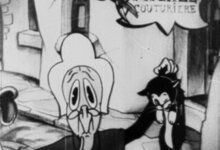
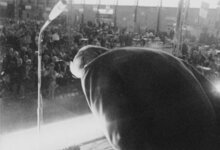
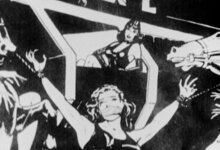
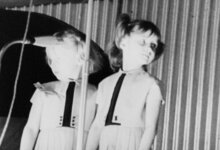
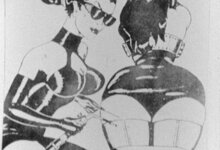
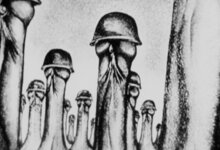
"Le Saigneur est avec nous won the Lucien Deroisy Prize at the Tenth National Festival of Belgian Film. The subtitle "in memoriam Alfons Vranckx" clearly indicates that it is a pamphlet against fascism, here represented by a former Minister of Justice, whom a young woman manages to bewitch so that he abandons politics. Already the subject of censorship and various scandals, Roland Lethem was then summoned to the Ministry of Justice. The film begins with a televised address by the minister, whose voice the director removes and replaces with verses from a radio broadcast of a Mass sermon. This technique, drawn from surrealist collage and widely used throughout the film, characterised its first version, which ran just over two hours. It mixed scripted scenes, news reports, reconstructed interviews, advertising pastiches, clips salvaged from scraps and off cuts from the cinema archive, Nazi newsreels, cartoons, inscriptions scratched onto the film stock, erotic reels, and even fragments of Bandes de cons!, his previous film – of which Le Saigneur est avec nous is in some ways the logical continuation (it begins where the other ended, directly insulting the viewer in the opening scene).
Like several interwoven leitmotifs, certain shots recur at irregular intervals, as do numerous sung or orchestrated versions of "L’internationale". Through complex and technically surprising editing, these Mysteries of the Struggle Against Oppression and for Freedom once again confront the viewer with their own image. The title's vampiric allusion will come as no surprise, given that virtually all Lethem’s films use vampirism as a symbolic substitute for sexuality, along with the related theme of castration, both as subject matter and as a deliberate provocation (as also seen in La Ballade des amants maudits (The Ballad of Doomed Lovers), La Fée sanguinaire (The Bloodthirsty Fairy), Le Sexe enragé (The Enraged Sex)...)" – Boris Lehman
Digitized in 2024 by the Royal Film Archive of Belgium (CINEMATEK) with funding from the European Union – NextGeneration EU and with the support of the Wallonia-Brussels Federation. The work was carried out using the 16 mm internegative held in CINEMATEK’s collections, from which the film was digitized in 2K.
| distribution format | DCP on server (SMPTE 2K) |
|---|---|
| screen | 1,37 (single screen) |
| speed | 24 fps |
| sound | sound |
| rental fee | 314,00 € |
| distribution format | Digital file on server (FHD) |
|---|---|
| screen | 1,37 (single screen) |
| speed | 24 fps |
| sound | sound |
| rental fee | 314,00 € |